


Functional Movement Screening (FMS)
What is Functional Movement Screening (FMS)?
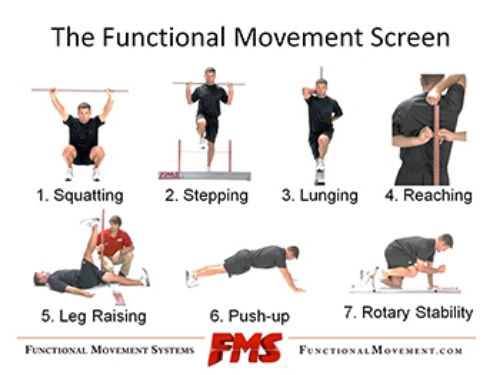
The Functional Movement Screen (FMS) is a series of seven movement tests, designed to identify functional limitations and asymmetries in movement patterns. The FMS looks at fundamental movements, motor control within movements, and a competence of basic movement patterns. Its job is to determine movement deficiency and uncover asymmetry. Each test is scored on a scale from 0 to 3:
0 — Pain felt during movement. 1 — Inability to perform or complete a functional movement pattern. 2 — Ability to perform a functional pattern, but with some degree of compensation. 3 — Unquestioned ability to perform the functional movement pattern.
The seven FMS tests are:
Overhead Squat
Inline Lunge
Hurdle Step
Rotary Stability
Trunk Stability Push Up
Active Straight Leg Raise
Shoulder Mobility
What are the benefits of FMS?
There is a saying that “something is only as strong as its weakest link.” The FMS strives to identify the weak link and correct it. The FMS looks at fundamental movement patterns, which are the foundation for fitness and performance. Oftentimes people are putting exercise and performance on top of dysfunctional movement, which can impair performance and cause injuries.
On top of identifying movement deficiencies, the main goal of FMS is to minimize the risk of injuries in athletes who have such asymmetry's. The information gathered from FMS tests allows coaches to implement a corrective exercise strategy to improve or normalize functional movement patterns.
Conclusion
The FMS is simple, but highly reliable and effective means of testing an athlete, and thus allowing for coaches to minimize injury risk. It is a useful tool for improving an athletes performance.
Comments